Think back to your last global ad campaign or website go-live. You finally had all your English assets ready to launch – and then realised you still needed to adapt them for your other markets.
Translating your content is one thing, but making it work in another market is something else entirely. Translation alone isn’t enough. What you need to make your marketing content pop in other languages is transcreation: translation + recreation.
I’ve covered the difference between translation and transcreation before. In this blog post, I’ll walk you through three (very good) reasons why you need a transcreation specialist by your side if Germany is on your radar!
What does a transcreator do?
A translator’s job is to relay what the original text says. A transcreator recreates that text to inspire a targeted audience to respond in a specific way and take specific action. That could be anything from signing up for an email newsletter to buying a product from a website.
More often than not, transcreation is what brands really mean when they ask for “marketing translation,” “creative translation,” or even just “translation”. Transcreation blends translation with copywriting to increase a brand’s persuasive power.
Let’s look at what’s in it for you when you decide to work with a transcreator.
You get to the core of the matter
Your transcreation partner does a lot more than adapt words from language A to language B.
By combining
- marketing strategy
- translation
- and copywriting skills,
they take your message and make it work for an entirely new market.
This is what that message shift can look like in practice:
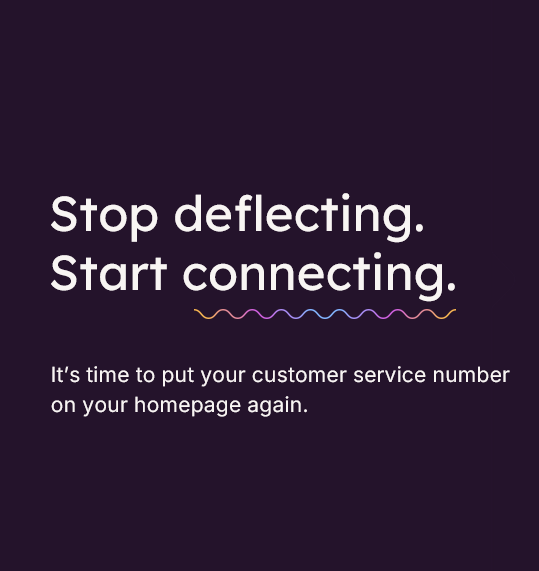
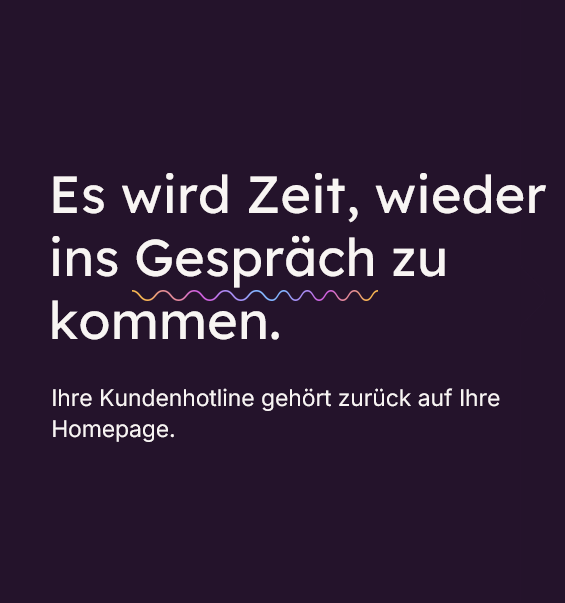
The top image shows some English sales deck copy; the image below shows a German transcreation of that copy.
The back-translation reads: “It’s time to get talking again. Your customer service hotline belongs back on your homepage.”
The original relies on rhyme (“deflecting”, “connecting”), which works well in English and gives the copy a playful feel. But it wouldn’t hit the same in German.
That’s why the German version takes a different route and focuses on the core message instead: getting your customer conversations going again.
While the words sound quite different, the essence remains. And what’s just as important, the recreated copy now sounds natural and makes sense to a German speaker.
Rather than being able to hear the English original through the German copy (which often happens with direct translations), the intended audience feels that this text was written specifically for them. That means you’ve not lost them in translation. They’re still engaged with your content, and that’s exactly what you want.
You still sound like you
At some point, someone at your company (maybe you?) put a lot of time and energy into shaping your brand voice. As a result, you now have guidelines that document what you say and how you say it.
So, how do you protect your brand voice when expanding into another country?
Option A: You can hire a creative agency in your target country to come up with a whole new set of guidelines – which can be costly and mean too many decisions are being made without you.
Option B: You can work with a transcreator.
This allows you to communicate directly with a wordsmith who will consider your English brand voice and make careful tweaks when localising your content for German audiences.
Something I often find with English-speaking brands is that they don’t have to think about gender-inclusive language in quite the same way as brands working in other languages do. In German, for instance, “Gendern” is a big deal – and there’s more than one way to go about it!
So, whenever I create a German content style guide for my clients, I make sure we align on how to handle gender-inclusive language, form of address (du, ihr, or Sie?), or even whether or not to hyphenate compound words that include the brand name.
If you’re thinking, “Phew, I’ve never considered any of that before,” you’re definitely not alone. But that’s why it’s all the more important that you share your content with someone who has considered this – and lots more – on your behalf.

You don’t embarrass yourself
Ad campaigns are especially prone to lacking cultural context. A copy-and-paste approach just doesn’t cut it.
To connect with your German audience, you need to incorporate local customs and traditions. For example, did you know that Christmas stockings aren’t really a thing in Germany? Or that Secret Santa-style gift exchanges are known as Wichteln?
Similarly, humour doesn’t always travel beyond borders. While Germans do enjoy a sarcastic joke here and there, British sarcasm can go right over their heads (I applaud you for it, though!).
A culturally sensitive localisation partner will help you get your foot out of your mouth!
Why use a transcreator when entering the German market?
When you’re entering the German market, you want your message to land, your brand to still sound like you, and your content to make sense to your new audience. A German transcreator helps you get all three right.
Thinking about expanding to Germany? Talk to me first!
view here